
A print on demand (POD) order works very differently from a classic wholesale print job. In wholesale you print hundreds of units of the same design. In POD you get dozens of different designs, colors and sizes over the course of a day, most of them as single units. That is why the answer to "which print method is better" changes when POD orders are involved.
Screen printing is still strong for high-volume jobs, but it needs a separate screen for every color, which makes it inefficient for one-off orders. So two digital methods lead in POD shops: DTG (direct to garment) and DTF (direct to film). In this post we compare the two from a shop owner's point of view, based on the POD order profile.
How does DTG work?
With DTG, a specialized printer prints the design directly onto the shirt. The ink soaks into the fibers, so the print feels like part of the fabric. On light shirts you can usually print color directly. On dark shirts, a pretreatment liquid is applied first, then a white underbase is printed with the color layer on top. After printing, the ink is heat cured so it stays put.
- Gives the best results on high-cotton fabrics.
- Soft hand feel; on light shirts the print is barely noticeable to the touch.
- Handles photographic, multi-color designs with gradients well.
- On dark garments, pretreatment and the white underbase add steps and time.
- Printers need regular maintenance; daily use matters to keep print heads from drying out.
How does DTF work?
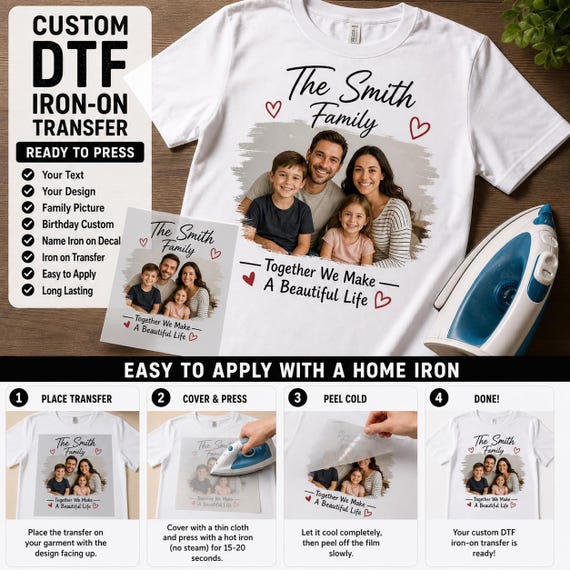
With DTF, the design is first printed onto a special PET film. A white layer is added behind the color layer, adhesive powder is applied to the wet ink, and the film is cured. The finished transfer is then applied to the shirt with a heat press and the film is peeled off. In other words, printing and applying to the garment are two separate steps.
- Works on a wide range of fabrics, including cotton, polyester and blends.
- The same workflow applies to dark and light garments; no pretreatment needed.
- Transfers can be printed ahead of time and stored; the press step can be scheduled separately.
- The print sits on the surface as a thin layer; the hand feel is more noticeable than DTG.
- Large solid areas feel heavier; designs need to be prepared with this in mind.
Side-by-side comparison
| Factor | DTG | DTF |
|---|---|---|
| Fabric fit | Best on high-cotton fabrics | Works on cotton, polyester and blends |
| Dark garments | Requires pretreatment and a white underbase | Same workflow, no pretreatment |
| Hand feel | Soft, blends into the fabric | Thin layer on the surface, more noticeable |
| Single-unit orders | Suitable, no screens | Suitable, no screens |
| Product range | Strong on cotton products like tees and sweatshirts | Flexible across surfaces like totes, aprons and hat panels |
| Workflow | Prints on the garment in one step | Film printing and pressing are two separate steps |
| Planning | The garment must be ready at print time | Transfers can be printed ahead and stored |
Which one leads for POD orders?
Most POD orders are cotton or cotton-blend products such as t-shirts, sweatshirts and hoodies. Buyers notice a soft hand feel on these orders and reward it with positive reviews, so DTG is a strong choice for light cotton products. On days when dark garments dominate, the pretreatment and drying step can slow down a DTG line.
DTF's strength is flexibility. When a high-polyester product, a tote bag, an apron or a different surface comes in, you use the same line. Printing the transfers for the day's orders in a batch and running the press step at a separate station also makes it easier to balance labor.
Questions to help you decide
- What share of incoming orders are dark garments? If it is high, calculate your pretreatment capacity for DTG.
- Is your product range only cotton tees, or do you also handle polyester, totes and aprons?
- Is your daily workload uneven? Printing and stocking DTF transfers ahead of time can smooth out the peaks.
- How many stations can your team run at once? DTF is two steps, DTG is one.
- Do you have a daily routine for machine maintenance? DTG needs regular use.
Using both methods together
Many shops use both: light cotton tees go to the DTG line, while dark and non-cotton products go to the DTF line. This hybrid setup protects both quality and speed because every order goes to the method that suits it best. The key is to write the routing rule down clearly so the team makes the same decision on every order.
The two methods also differ on the file side. In DTF, semi-transparent pixels, soft shadows and glow effects can produce unexpected results together with the white layer; these gradients need to be converted to a halftone pattern before printing. In DTG, on dark fabric, the file needs clean edges so the white underbase does not spill past the edges of the design.
Getting a shop ready for POD orders
Whatever the method, what defines quality in a shop that takes POD orders is the workflow: matching the right file to the right order, checking product, color and size, keeping print placement standard, and shipping on time. In the Custombull producer network, orders reach you with the product, color, size and a print-ready design file; the shipping label is on the same screen. Orders from the same customer are combined and shipped in one package.
Custombull gives sellers a quality guarantee: if a defective product reaches the customer, the seller is refunded with no questions asked, or the item is reprinted for free. To keep that promise, every producer in the network is expected to take the same care. In the last 60 days, half of all orders shipped in under 2.8 days (median, from order to shipment).
Frequently asked questions
Is DTF more durable than DTG?
Durability depends more on execution than on the method: proper curing, correct press settings and the right wash instructions. Both methods, done well, are durable enough for POD orders. Running wash tests with your own materials is the soundest approach.
If I'm starting with one machine, which should I choose?
Look at your order profile. For work that is mostly light cotton tees, DTG; for a mix of fabrics and product types with lots of dark colors, DTF can be the more flexible starting point.
Can the seller choose which method is used?
In POD, the seller usually chooses the product, color, size and design. The method is chosen based on the producer's workflow and the product's fabric. What matters for a shop is that the result meets the same quality standard whichever method you use.